

Missing Birds Gone to Space
I don’t ever want to go to the moon. I’m sure it’s beautiful there this time of year, but I’m susceptible to earthsickness. I’ve stumbled on one of those lovely divergences: to be homesick is to want, to feel the lack of home; to be seasick is to feel the lack of…land. Under one’s feet, and also somehow in one’s head—in the inner ear, the vestibular system. The nausea of kinesthetic, proprioceptive disorientation in space is, more broadly, motion sickness. So there are sicknesses named for what’s lacked, and those named for the source of displacement. Except, the OED records for “seasick” a “nonce-use [after homesick adj.]. Longing for the sea.”
Earthsickness would get you coming and going, because it is a missing of the earth, and a nausea from being on the earth, itself sick. The excellent compound noun, “earthship,” is the “earth, regarded figuratively as a ship travelling through the heavens, space, etc.” Space becomes a sea, so that even with the solid ground under our feet, it is possible to feel that we are all perpetually tossed.
Migratory birds, especially those kept in confinement, are known to suffer something called Zugunruhe, borrowed from German but more often occurring in English contexts, “migratory restlessness.” According to the Oxford Dictionary of Zoology, Zugstimmung is: “In birds, the mood of migration.” Describing an experiment with migratory songbirds called Eurasian blackcaps in Radolzfell, Germany, ornithologist John Rappole explains in his Bird Migration: A New Understanding (2022), “when the time for the initiation of migratory flight (Zugstimmung) arrives, they attempt to take off at dusk. If they are prevented in some way, as by being held in a small cage, they will simply repeat takeoff over and over throughout the night, and for each night thereafter for weeks.” If that isn’t motion sickness, I don’t know what is: the sickness of being held back from a movement towards which one is existentially oriented.
I’ve found what I think is a reference to Zugunruhe, in one of the earliest works of science fiction—Francis Godwin’s The Man in the Moone; or, Discourse of a Voyage Thither (1638). Narrated by a spritely Spaniard, Domingo Gonsales, it is a picaresque adventure I commend to anyone who enjoys a good yarn. This Domingo Gonsales embarks on an experiment in aviation: he partially domesticates, raises up and trains a flock of wild swans (which he calls gansas) to be harnessed to a device which enables them to carry “burthens,” starting with a lamb and ending with himself. He distributes the weight equally among them by a system of strings and pulleys with corks. Eventually, he avails himself of this ingenious contrivance (his living “Engine”) to escape a dicey situation at sea. Rather than merely carrying him to safety, as he anticipates, the swans involve him in “the strangest Chance that ever happened to any mortall man,” carrying him “upward, and still upward” until, long story short, they land on the moon. There, he will encounter an idealized lunar people with an untranslatable language, in whose clothes he perceives colors with no earthly correspondence.
Given all that is unmatched in the lunar world, it is striking how explicit he is about not only the likeness but the identity of the creatures that divide their time between the two worlds, for whom they are but limits of a single world:
I found not any thing there, any species either of Beast or Bird that resembled ours any thing at all, except Swallowes, Nightingales, Cuckooes, Woodcockes, Batts, and some kindes of wild Fowle, as also of such Birds as my Gansa’s, all which, (as now I well perceived,) spend the time of their absence from us, even there in that world; neither do they vary any thing at all either in quantity or quality from those of ours heere, as being none other then the very same…
Domingo Gonsales finds out where birds (and bats) go without meaning to, in a process that escapes his control. And then, he is insouciant. I am strangely drawn to the thought that this age-old mystery of avian seasonal disappearance is elucidated by such an unprepossessing figure; and that the discovery itself seems to make so little an impression upon him.
It has taken a long time, and the coordination of observers in many distant parts of the earth, to begin to comprehend the phenomena of long-distance avian migration. There were those who once thought swallows submerged themselves in the winter, in the mud at the bottoms of lakes. Aristotle thought the European robin of winter became the redstart during the summer. Hibernation has been the most prominent alternative theory to migration. And ornithologists now know that the truth is mixed: migration is certainly more common, but some birds will indeed go into torpor. One species, the Common Poorwill, can do so for up to weeks at a time. Hummingbirds can go into torpor for shorter periods, but many also migrate. There are now highly sophisticated tracking technologies, and much more is known about avian migratory instincts, flyways, timing. But avian migration, as embodied, is still something that happens at and over distances remote from grounded human bodies. A migratory bird makes contact with the ground, and things that rest upon or emerge from the ground, in a way that always includes the possibility of lifting off. Along with bats and many insects, it also dwells utterly in the air. People will say we humans have achieved flight too. But how cumbersomely! In an airplane, my body is cramped, my head aches, my ears suffer a sharp pain of pressure on ascent and descent. It is not me who flies. I am probably nearer embodied flight when I walk with a spring in my step, or dance, than when seated in an airplane.
There’s a picture on the frontispiece of The Man in the Moone: Señor Gonsales seated on his “Engine,” drawn by 10 of these gansas, aloft above a mountain peak, on his way up and up, with the moon towards which he is destined in the upper lefthand corner of the frame. There is something so delicate, so exposed, about Gonsales in the picture. He looks as if he’s just on a capricious sort of makeshift swing-set, a dubious fairground ride—yet we in the twenty-first century know that he’s headed for a fatal pressure change, and for a freezing, unbreathable atmosphere that is not earth’s. He is on his way to a place where no one will hear him scream. And what if he falls from his perch? He is reckless, vain, proud of his invention. Why is it my heart goes out to him?
Towards the end of his sojourn on the moon, Gonsales realizes he and his swans must return to earth or forever hold their peace: “My Birds began to droope, for want of their wonted migration, 3 of them now dead, and if a few more failed, I was for ever destitute of all possibilitie of returning.” This “drooping” as a result of prolonged detainment on the moon is where I find something reminiscent of the agitation observed in those Eurasian blackcaps kept in cages, provoking Zugunruhe. When Gonsales bids farewell to the gracious and exquisite lunar peoples, he says, “I let loose the raines unto my Birds, who with great greedinesse taking wing quickly carried mee out of their sight…” Expressing the force of migratory instinct, this “great greedinesse taking wing” conveys something more than desire, or even need. What a fierceness of instinct must it be, to muster the energy, the unhesitating nerve, to traverse such distances, to be at such hazard. A celebrated extreme for distance-to-body-size ratio is the famously pugnacious rufous hummingbird, weighing 3-4 grams, who makes twice-yearly trips between 3,000-4,000 miles (between Alaska and Mexico). It is no wonder such creatures do not readily accept the conditions of detainment, even when resistance is futile. More to be wondered at is the infernal curiosity of those compelled to measure and record the intensity of this instinct when thwarted.
If birds really did migrate to the moon, what are the chances some enterprising soul would not have exploited their transit; or found a way to hitch a ride, just to see that other world, whatever the cost? And, how many would not have wanted to follow? Who wouldn’t want to be carried up, and up! I understand too well, and feel the earthsickness coming on, when I read the last words in the story of Godwin’s irrepressible Domingo Gonsales, the little man who went to the moon and back on a whimsical swing suspended from a flock of wild swans. He has landed in China, and with his courteous hosts he makes plans for his return to Spain. “With them also did I lay a foundation for my returne, the blessed houre whereof I doe with patience expect; that by inriching my Country with the knowledge of hidden mysteries, I may once reape the glory of my fortunate misfortunes.”
*
Later in the same century, the nonconformist minister and man of science, once a teacher of Daniel Defoe, Charles Morton tried the explanatory power of lunar migration as a theory for avian seasonal disappearance. Unlike Godwin’s Gonsales, Morton does not exploit the phenomenon he would explain in Essay Towards the Probable Solution of this Question: Whence Come the Stork and the Turtle, the Crane and the Swallow, when they Know and Observe the appointed Time of their Coming; or, Where those Birds do probably make their Recess and Abode, which are absent from our Climate at some certain Times and Seasons of the Year. (1703, but first published in a slightly different form, probably around 1694). The title in its luxuriance alludes to the scriptural basis for Morton’s belief that this solution really is “probable.” The essay begins by quoting from Jeremiah 8:7, “The Stork in the Heaven knoweth her Appointed Times, and the Turtle, and the Crane, and the Swallow observe the Time of their Coming.” Much hangs for Morton on the meaning of “in the Heaven”—he is convinced that it refers in this case to the “Ætherial Heaven” (of the three scriptural Heavens, this one contains the planets, stars and moon). He considers it a piece of solid evidence, reason number two in support of his theory: that the birds arrive so very suddenly, “as if they dropt down upon us from above” and sometimes “all in a Night.”
The sober theological reflections of Morton bring all the more into relief the fantastic improbability of the “probable solution” he proposes. The most irresistible reason he gives in support of its probability is reason number five, which contains an observation of something like Zugstimmung:
Consider these Fowls in, or near the Times of their Departure, the Woodcock (as was said) is full of Blood, gets Company; […] the Fieldfares and Redwings gather into great Flocks, so do the Swallow and Marlets; and all these except the Woodcock, are wont to make a chearful singing or chattering Noise, before they take their farewel; their Flights are also high, but never over any Sea-Water that I can hear of; therefore I conceive they leave not the Land to go beyond-Sea, nor is it probable that they hide in Sand, or seek lurking Places to sleep in; for then methinks they should be more dull and drooping towards their going to sleep: No, rather their Chearfulness seems to intimate, that they have some Noble Design in Hand, and some great Attempt to set presently upon, namely, to get above the Atmosphere, high, and flie away to the other World.
Given their manifest, incontrovertible high spirits, it is most probable that birds winter on the moon. They could not possibly be so happy to remain anywhere on earth! But then, Morton is just hitting upon something that can, in any season, confound a person about birds. It will almost always seem to us in excess of what’s called for, the unstrained exuberance of which birds are capable. Earth, such as it is, does not seem to warrant their enthusiasm. Thomas Hardy noted the heedless joy of “The Darkling Thrush” at the turn of the twentieth century: there must be, he concluded, “Some blessed Hope, whereof he knew/ And I was unaware.” When I wonder whether the birds I encounter are on any level aware of their steeply declining populations, of how bad things really look for their continued existence, made plain to us in the most recent North American and global State of the Birds reports; a small, teasing voice of rejoinder hints that the birds might not have gotten the memo, but there is something else they do know.
*
The atmospheric problem of outer space for living beings became clear, according to the maverick “space archaeologist” Dr. Alice Gorman in Dr Space Junk vs. the Universe (2019), in 1648 when Blaise Pascal and Florin Périer “built a mercury-filled barometer to measure air pressure, and climbed the highest mountain they could find.” Pascal reasoned then “that there was a vacuum above the atmosphere,” which turned out to be true, and to mean that space travel was to be a biological as much as a technological problem. In the present, human designs upon the moon, and upon outer space more broadly, entail a technological alteration of environment not fully conceived as a problem by Godwin and Morton. These texts seem to respond intuitively to the fact that the moon is already ecologically intertwined with the earth—it pulls on the tides, its light conditions earthly life. Their embellishment, their beautiful error, is to elaborate a lunar ecology as profuse as that of the earth; so that the moon is not only integral to earth’s life, but a luminous alternative center of life. The moon here is not really a solution to the problems of earth, but an already complex, already inhabited sphere. Insofar as The Man in the Moone does present a kind of utopia, this is undermined by the naturalized seasonal traffic between moon and earth.
Godwin, though his work was published (posthumously) a decade before Pascal and Périer’s experiment, does seem to have allowed for a period of atmospheric adjustment: the swans alight, on the way up, at the top of a hill called “El Pico, […] a place where they say never man came before, being in all estimation at least 15 leagues in height perpendicularly upward, above the ordinary level of the Land and Sea.” Here,
I saw my poore Gansa’s, fall to panting and blowing, gaping for breath, as if they would all presently have died: wherefore I thought it not good to trouble them a while, forbearing to draw them in, (which they never wont to indure without strugling) and little expecting that which followed.
Morton does not seem to have been troubled by the problem of atmosphere—or rather, he embraced the idea of freedom from atmospheric resistance as an aide to travel, but not as a physiological problem. And he used the word Atmosphere, in reasoning that the exuberance of migratory birds prepared them “to get above the Atmosphere, high, and flie away to the other World.” He was using it in the sense the naturalist Robert Plot specified in 1677: “That subtile Body that immediately incompasses the Earth, and is filled with all manner of exhalations, and from thence commonly known by the name of the Atmosphere.” As the OED notes, a curious fact about this word is that it was first used “in connection with the moon, now believed to have none.” (NASA will tell us, with greater precision, that the Moon does have a very thin atmosphere, limited to the layer of the “exosphere,” composed mostly of helium, neon and argon.) But the supposition that this Atmosphere of the earth is something birds could want to “get above” reverberates in the present, in a way Morton could not have foreseen: birds, heading for the moon in order to leave behind earth’s increasingly volatile climate, this miasma.
*
“Space, vast space,” wrote Gaston Bachelard, “is the friend of being.” He meant space, l’espace, more generally than outer space—but what could be vaster? The capaciousness of Bachelard’s conception of space is evident in the range of ways he addressed it: confined and mundane as a drawer or cupboard; and dilating outward to the universe. It was the “daydream” or reverie he held out as quintessential to the experience of poetic space, broadly construed. That mode of dreaming diurnally, awake (again in Maria Jolas’ translation): “Poetry comes naturally from a daydream, which is less insistent than a night-dream.” Daydreaming, wide awake, I encounter an alternative world in these 16th-century texts of avian migration to the moon. Not a scientific alternative, even if Morton meant his treatise in earnest, it has to do with that “chearful” precarity proper to the being of birds. Now, the question of Where those birds do probably make their Recess and Abode, which are absent from our Climate is not only seasonal, but cumulative. Where have they gone in their billions, from which they no longer return? They’ve gone to space, vast space. I might be moved by their innocence of the catastrophe befalling them, befalling us all. Or I might, daydreaming, catch a bright glimpse of what Morton wondered at: something surpassingly wonderful and worthy of gladness, which birds “know and observe,” and I am unaware.
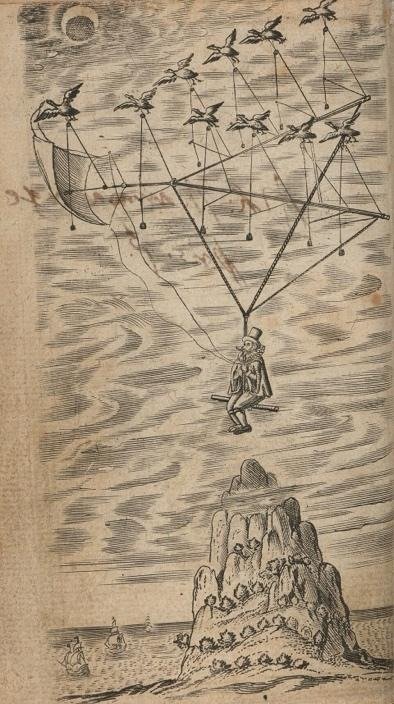
Frontispiece of The Man in the Moone (1638) STC 11943.5, Houghton Library, Harvard University