
Reverently Irreverent: A Review of Rebecca Gayle Howell’s Erase Genesis
Irreverence undermines something held sacred; to have reverence implies a sacred nature about the subject of attention. Erase Genesis by Rebecca Gayle Howell blacks out, with blue watercolor, the King James Version text of the Holy Bible to draw out more meaningful connections, and understandings, of this historic text, a text many of us have encountered and, according to Erase Genesis, many of us may have misunderstood.
The book opens with the full text of the first three chapters of the Book of Genesis in their KJV translation. It then proceeds to “erase” Genesis across five total chapters. The poet first erases each chapter in order, then closes with an alternate erasure of the second, then first, chapters. Howell evokes both Thomas Merton and Meister Eckhart in the afterword. Merton was a Christian mystic in Kentucky, where Howell herself is from, and once said “[r]ecollection is awareness of the unconditional” (136). An Eckhart meditation opens the book, but another appears in the afterword along with Merton’s: “Nothing in all creation is so like God as silence” (136). Informed by both these thinkers on poetry and divinity, Erase Genesis looks to recollect the original intention of Genesis’ language, find God between the silences.
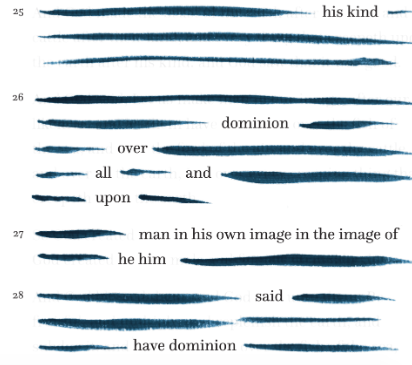
Rather than the traditional blackout where text is erased using a black, digital rectangle or a black pen by hand, Howell paints over the text of Genesis using blue watercolor. This is part of how she engages with theologian Ellen F. Davis’ concerns over the translation of Genesis 1:26-28: “…let them have dominion over the fish of the sea…” Davis states that “mastery among” is a more apt translation, which brings us closer to the original Biblical Hebrew of the source text (138). It is this translation loss that fascinates and drives Howell in Erase Genesis. She treats the work of erasure of the first three chapters of Genesis as an act of “chasing” a closeness with the text (137).
Howell’s desire to find closeness with the text rather than outright “erase” the text in the negative sense is not the usual erasure we know. She states in the afterword that erasure typically works “against” a text, often taking back control of a hateful or discriminatory legal document, historical text, news article, etc.; Erase Genesis does not follow this attitude (135). The erasure poetry of Erase Genesis imagines, or reimagines, the biblical creation myth as a story that denies man and woman this “dominion” over the earth that concerns Davis and instead positions the man, specifically, as witness to the creating acts of both the earth and the “Lord woman.” The text reinterprets man’s duty to the earth: a kinship and not an ownership.
The hand-painted aspect of the erasure and her attention to the act of literary translation, Howell states, helped her approach Erase Genesis as “a kind of literary translation” where she could “participate in its creation” (140). The watercolor erasure places the poet in the role of creator, not just creator of the text but of the world, and her reader becomes her witness. We see the roiling water(color) over the white space of the page; we see the waters divide and the dry land of language lifted out from them.
(20)
Initially, the erasure here would seem to confirm the original understanding of “dominion.” We might reasonably take the opening erasure to reaffirm man’s duty of dominating the earth. Though, the painted waters shift as we return to the beginning of the first chapter of Genesis. “Or… Or / Or,” the text states across three full pages of painted erasure before the voice of the poem says, “the earth / the sea / the air / over / you” (23-27). When the only words to appear across multiple pages are multiple instances of “or,” the reader gets more of a sense of “thought” at work on the page. Beyond the conventional line-break-and-white-space action of a traditional poem, Erase Genesis is limited—or, rather, aided—by the reader’s eye requiring movement across the watercolor lines, a physical act of the thought-process of the speaker as they reconsider the original bestowal of dominion.
By lifting and sinking language up from and into the deep waters of the page, the poet conjures up this world in which mankind no longer holds “dominion over” the creation of God, but is invited “among” the trees, the beasts.
(96)
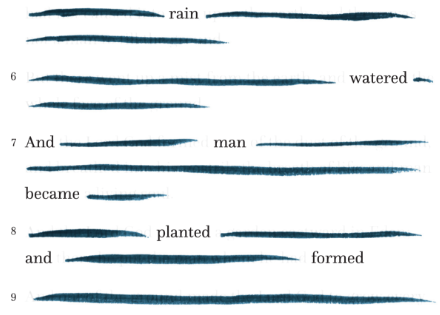
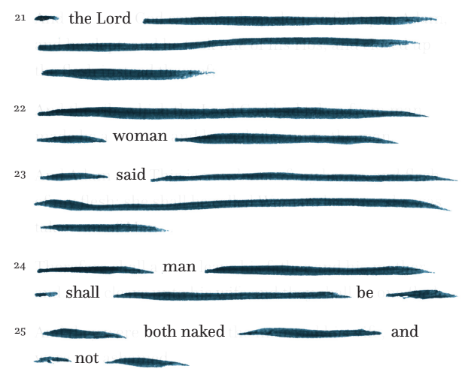
The earth is allowed, here, to flourish uninhibited by man’s interruption, by man’s initial lack of knowledge of how the world works, how it wants to live. “[T]he earth / breathed into his nostrils / a garden / And / the same / man / commanded / man should be alone” (48-49). Erase Genesis’ radical ecology turns the knowledge, the breath of life from man alone toward every piece of creation equally: “But / the ground / formed / dust / a living soul / And / knowledge / parted / And / it / goeth toward / every beast / and / fowl / And / found / the Lord / bone / of / Woman” (56-58). The text resets creation as we understand it through the KJV. It completes the deconstruction of the known binaries: good versus evil, man and woman, mankind and creation, God and us. With this completed through the first three sections, “the Lord woman” rebuilds. She teaches us to listen to the seeds, the dust, every creeping thing.
(106)
The new creation is rooted not in power and dominion, but tenderness and cohabitation with the land. Man, earth, the Lord woman, the reader recollect the unconditional: that all of creation at the end of the seventh day is good and of equal consideration in the Lord’s sight.
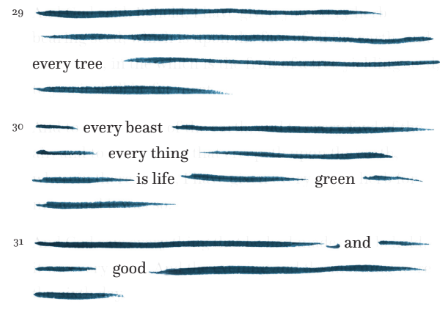
(125)
Looking back on Ellen F. Davis’ offering of “mastery” for the translation of the original source text over the known “dominion” makes a difference. The Oxford English Dictionary’s first definition of “mastery” is “comprehensive skill or knowledge in a subject” (139). This does not remove the onus God placed on man to be fruitful and multiply, to be a good steward of this Earth we call home. However, it also doesn’t place humans on the pedestal society has themselves created to separate us from the beasts and fowl of the fields. Howell writes, “[b]e as the shepherd is to the sheep… To dominate is intimacy’s opposite” (140).
The Word here is reshaped into something more tender, and perhaps closer to source text’s intended purpose. An act many would consider irreverent, the blacking out of a holy text, is done with care and compassion and approached with a reverence that affirms the poet’s good intentions. The Lord woman shows us a world in which we can cohabit with the living flora and fauna placed here with us. The reader closes the poem with a new perspective on “being” and what it means to be a soul-bearing participant on this living earth. And the poet herself? She has come to the perimeter of Eden and has met the flaming sword guarding it, and that sword has granted her entrance that she might aid us in recollecting a higher presence than ourselves.
I leave you with the words of the poet:
“I do not come to the text to assault it or upstage it. I come to know it. And in knowing it, I become a part of what really does want to be fruitful and multiply: the human imagination for connection.
The Book of Genesis can never be erased. (140)”